
You obsess over your coffee beans, but customers complain about value or comfort. The cup size is the silent factor you have overlooked, impacting their entire experience.
Coffee cup size is a powerful psychological tool1 that shapes customer experience2 by influencing their perceived value3, ease of handling4, the drink's temperature5, and their overall portion satisfaction6.

As a coffee shop owner, you focus on the details that make your coffee great: the origin of the beans, the perfect grind, the water temperature. But there's one critical element your customer holds in their hands every single time. It can silently make or break their experience: the cup itself. The size of your coffee cup isn't just about how much liquid it holds. It's a powerful tool of perception and psychology. In my 20+ years of making cups, I've seen how the right cup size strategy can elevate a brand. Let's explore the four critical ways cup size impacts your customer experience2 and, ultimately, your business's success.
How Does Cup Size Affect a Coffee's Perceived Value?
You serve amazing coffee, but it doesn't feel special to customers. They don't see the value you offer, hurting your premium pricing strategy7.
A larger cup can create a feeling of generosity and good value. A smaller, more elegant cup can signal high quality and make a premium coffee feel more special.

The size of the cup is the first visual cue your customer gets about the value of their purchase. This perception is a delicate balance. I always tell my partners to think about their brand story8 first. Are you the best value on the block, or are you a high-end craft destination? Your cup size must tell that story before the customer even takes a sip.
The Psychology of Size and Price
I had a client who sold a very rare, expensive single-origin coffee. They were serving it in their standard 12oz cups, and customers didn't understand the high price. It just felt like a regular coffee. I suggested we produce a special 6oz cup for this specific bean, one with a thicker feel and a more elegant design. Almost immediately, customer perception9 shifted. The small cup signaled that this was something concentrated and special, a treat to be savored, not a big cup to chug. It justified the premium price. The opposite is also true. For a shop focused on commuters, a 12oz "small" feels far more generous and valuable than a traditional 8oz cup.
| Brand Identity | Cup Size Strategy | Customer Perception |
|---|---|---|
| Value-Oriented / Commuter Cafe | Larger "standard" sizes (e.g., 12oz Small) | "I'm getting a lot for my money." |
| Specialty / Craft Coffee Bar | Smaller sizes for premium drinks (e.g., 6oz Flat White) | "This is a high-quality, special treat." |
Can the Wrong Cup Size Make Your Coffee Uncomfortable to Drink?
A customer grabs their morning coffee, but the cup is too wide to hold or spills in their car. This daily annoyance can silently drive your regulars away.
Yes. An impractical cup is a major problem. A cup that is too wide is hard to hold, and one that doesn't fit in a car's cup holder is a deal-breaker for commuters.

The "hand-feel" of a cup is a deeply subconscious part of the experience. My background is in mechanical engineering, so I think about ergonomics10 and stability a lot. An uncomfortable cup can be a daily annoyance that sends customers to your competitor. You have to know your primary customer. If they are drivers grabbing coffee on their way to work, you must pass what I call "The Commuter Test11."
Designing for Your Customer's Routine
The Commuter Test11 is simple: does your cup fit securely in a standard car cup holder? I have seen shops lose business because their 12oz and 16oz cups had a base that was too wide. This is a frustrating design flaw for any customer on the go. Beyond the car, think about general comfort. A cup that is too wide can be difficult for some people to hold securely with one hand. On the other hand, a cup that is very tall and narrow has a high center of gravity. This makes it feel top-heavy and at risk of tipping over easily. The ideal cup feels balanced and secure. This is where cup design innovations, like the double-wall or ripple cups we produce, really excel. They provide insulation and a better grip without needing an extra sleeve.
How Does Cup Size Change How Long Your Coffee Stays Hot?
You serve a perfectly crafted latte, but ten minutes later, the customer is drinking a lukewarm, disappointing beverage. The experience is ruined before it's over.
Cup size directly impacts heat retention12. A larger, wider cup has more surface area exposed to air, causing the coffee to cool down much faster than coffee in a smaller cup.
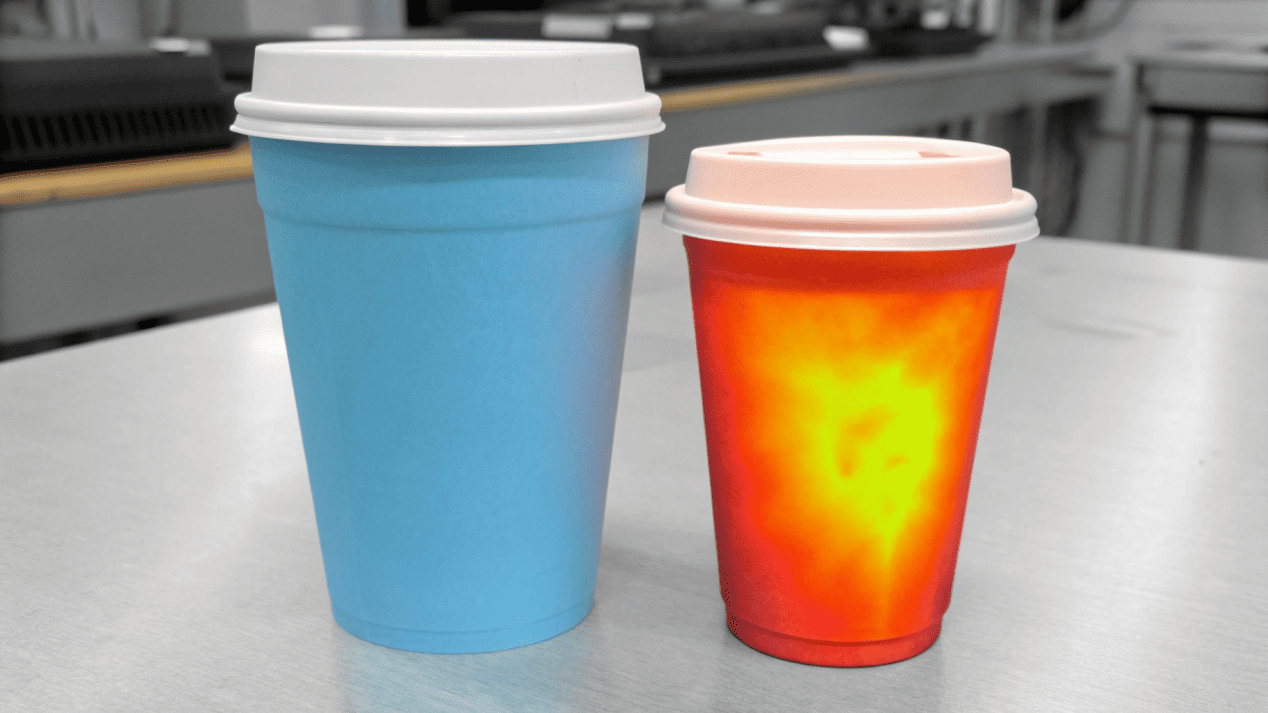
This is pure physics, but it has a huge effect on customer satisfaction. You need to think about the surface area of the coffee. A larger volume of coffee in a wide cup has more surface area exposed to the air. More surface area means faster heat loss. The drink cools down faster. A smaller, more compact serving in a narrower cup will stay hotter for longer.
The Physics of a Perfect Sip
Drinks with delicate milk microfoam, like lattes and cappuccinos, taste best within a specific temperature window. It is in this window that the sweetness of the milk is at its peak. A big 16oz or 20oz latte will fall out of that optimal window much faster than an 8oz one. The customer might not even be halfway through before the taste profile changes for the worse. There is a reason a traditional Italian cappuccino is small. It is designed to be consumed quickly, at the perfect temperature. I always advise my clients to guide customers toward smaller sizes (8oz, 12oz) for these specialty milk drinks to preserve the quality. For black coffee or Americanos that are sipped over a long time, larger sizes make more sense, especially if you pair them with an insulated double-wall cup.
Does Your 'Large' Coffee Feel Large Enough to Your Customers?
You list the ounces on your menu, but when you hand a customer your "large" coffee, they look disappointed and ask, "Is this it?"
No, because customers have a mental picture of what "large" means. If your cup is smaller than what they expect from other cafes, they will feel cheated, regardless of the quality.

This is what I call the "Is This It?" problem, and it's a very real one. When a customer orders a "large," they have an expectation in their mind. This expectation is built from years of buying coffee at other places. If your "large" is only 12oz, while the cafe next door offers a 16oz "large," your customers may feel short-changed. It doesn't matter if your coffee is far superior. The feeling of being cheated is powerful and can create a negative first impression.
Meeting Local Market Expectations
I always tell new shop owners: research your local competitors before you order your cups! Understand the sizing standards in your specific neighborhood or city. What does a "small," "medium," and "large" look like to your target customer? The best solution is always clarity. Clearly label your menu with the sizes in ounces (or ml) right next to the names. This helps manage expectations. A classic and widely understood lineup in many Western markets is 8oz (Small), 12oz (Medium), and 16oz (Large). This creates a logical and satisfying size progression13 that feels fair and familiar to the customer, while still letting you position your brand correctly.
Conclusion
Your coffee cup is a silent conversation with your customer. Strategic choices about size enhance value, increase comfort, and deliver a better-tasting product, building lasting loyalty.
Learn how to leverage psychology in your marketing strategy to boost sales. ↩
Discover key elements that shape customer experiences and drive repeat business. ↩
Explore how perceived value influences customer choices and pricing strategies. ↩
Find out how cup design affects customer comfort and convenience. ↩
Understand the science behind heat retention and its impact on taste. ↩
Explore how portion sizes influence customer satisfaction and perceptions. ↩
Explore strategies for justifying premium prices through perceived value. ↩
Discover how to communicate your brand identity through cup design. ↩
Understand how visual cues affect customer perceptions and choices. ↩
Learn about the importance of ergonomic design for enhancing user experience. ↩
Discover how to ensure your cups meet the needs of on-the-go customers. ↩
Explore the physics of heat retention and its effect on coffee enjoyment. ↩
Learn how logical size progression can enhance customer satisfaction. ↩