You assume your paper cups are safe, but the rules are complex. A single compliance failure could destroy customer trust and your brand, putting everything you have built at risk.
A truly compliant paper cup meets four key criteria. It adheres to global food safety standards1 like FDA2 and EU rules, holds third-party certifications3 like BRC and ISO, undergoes rigorous testing of all materials (paper, ink, coatings), and comes from a supplier who passes regular, thorough audits.

In my 15 years as an engineer in this industry, I have seen how seriously the best brands take this topic. It is not about just getting a certificate to hang on the wall. It is about a deep commitment to and a culture of safety. For us at Haokelao, compliance is not a department; it is the foundation of everything we build. Let's look at these four pillars one by one, so you can see what true safety looks like and feel confident in your packaging choices.
What Are the Most Important Food Safety Standards?
You hear terms like FDA2 and EU compliance, but it is hard to know what they actually mean. Choosing a cup that does not meet these basic rules could get your products rejected from major markets.
The most important global standards are the US FDA2 and the European Regulation (EC) 1935/2004. They set strict rules for raw materials and limit substance migration, which is anything leaching from the cup into the food.
I think of these standards as the laws of physics for food safety. They are the non-negotiable rules we must follow. Different parts of the world have different rules, but the two most important are the FDA2 in the United States and the EU regulations4 in Europe. They both aim for the same goal: making sure nothing harmful from the packaging can get into the food. They do this by controlling which raw materials are approved for use and by setting strict limits on "migration." This is a scientific term for making sure no tiny particles of paper, ink, or coating transfer to your drink. Following these rules also requires Good Manufacturing Practices5 (GMP), which simply means keeping the factory clean, training staff properly, and having strict hygiene controls. Adhering to these global standards is the only way to ensure your products are legally marketable and that you are meeting the highest level of consumer safety.
| Standard | Region | Key Focus |
|---|---|---|
| FDA2 | United States | Lists approved raw materials and substances that are safe for food contact. |
| (EC) 1935/2004 | European Union | Overall safety framework; no component materials should migrate into food. |
Why Do Third-Party Certifications Matter So Much?
A supplier tells you their products are compliant and meet all the standards. How can you really be sure without checking every single detail yourself? This uncertainty creates a huge risk for your business.
Certifications from organizations like BRCGS6, ISO, and FSC are independent proof that a manufacturer follows the rules. They offer unbiased assurance that your supplier operates at the highest level of quality and safety.
If standards are the rules, then certifications are the independent referee's final report. They are proof. These certifications are given by respected outside organizations that come into our factory and audit everything we do. They check our processes, our materials, and our quality management systems. I remember when we first went for our BRC certification. It was incredibly tough. The auditors checked every corner of our factory and every step of our process. Earning it was a proud moment for our whole team. It gives our clients immediate confidence that we do things the right way.
Here are the key certifications to look for:
- BRCGS6: A leading global standard specifically for packaging materials that focuses on product safety, quality, and legality.
- ISO 90017: This shows we have a strong quality management system, which means our processes are consistent and reliable every day.
- FSC®/PEFC™: These certify that our paper comes from responsibly managed forests, which is important for sustainability.
These are not just badges for our website; they are built into our daily operations.
What Exactly Gets Tested in a Food-Safe Cup?
You know the final cup needs to be "safe," but what does that really mean? A paper cup seems simple, but every single part of it must be individually tested to guarantee safety.
Every component is scientifically tested. The paperboard is tested for purity, the inks are tested to be food-grade and non-toxic, and the coatings are tested to ensure they provide a safe, inert barrier.
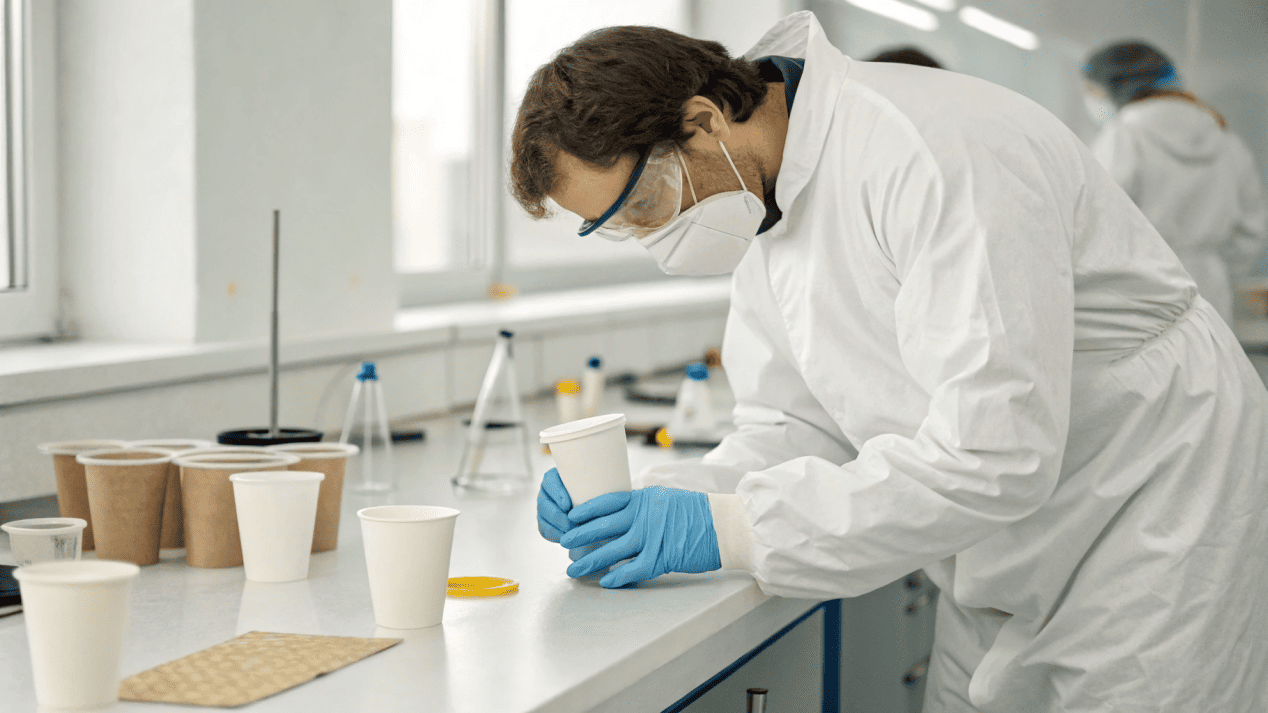
This is where the science of safety really happens. We cannot just assume that because our raw materials are approved, the final product is safe. We have to test it. We test every single thing that goes into the cup. The paperboard is tested to make sure it is pure and has no harmful contaminants. The inks we use must be special food-grade inks that are free from heavy metals and will not migrate. The coatings, whether they are PE plastic or plant-based PLA, are tested to ensure they create a completely safe and inert barrier. Finally, we conduct migration tests8 on the finished cup. We fill it with liquids that simulate different types of drinks (hot, acidic, etc.) to confirm that the combined components meet the strict safety limits under real-world conditions. We maintain a full "chain of custody9" for safety, from the tree to the finished cup. This is the only way to be absolutely certain the product is safe.
What Should You Look For in a Supplier Audit?
A supplier's certificate and test reports look good on paper. But what if their factory is messy or their workers are not following procedures? A piece of paper cannot show you the reality.
An audit verifies that the factory's daily practices match their promises. It assesses cleanliness, pest control, staff training10, material traceability11 from start to finish, and quality control checkpoints12 on the factory floor.

I have always believed in the principle of "trust, but verify." When you choose a supplier, you are trusting them with your brand's reputation. A factory audit is how you verify that trust is deserved. An audit means going beyond the paperwork and seeing the factory with your own eyes. It means checking that their real-life, day-to-day operations are as clean and professional as their sales brochure promises.
Here is what a good audit looks at:
- Cleanliness and Pest Control: Is the production environment spotless?
- Staff Training: Are employees following strict hygiene rules?
- Traceability: Can the factory track a specific box of cups all the way back to the exact roll of paper and batch of ink used to make it?
- Quality Control: Are there checkpoints throughout the production line to catch any problems?
This is why we not only welcome but actively encourage our clients to visit and audit our facility. We operate with total transparency. We are proud of our factory and confident that what you see will give you complete peace of mind.
Conclusion
Choosing a packaging partner is a critical decision. True compliance is not a feature; it is a fundamental promise that protects your brand, your customers, and your future success.
Understanding food safety standards is crucial for ensuring compliance and protecting consumer health. ↩
Explore the FDA's role in food safety to ensure your packaging meets essential regulations. ↩
Discover how third-party certifications provide assurance of quality and safety in manufacturing. ↩
Learn about EU regulations to ensure your products are compliant in European markets. ↩
GMP guidelines are essential for maintaining hygiene and safety in food production. ↩
BRCGS certification is vital for ensuring product safety and quality in packaging. ↩
ISO 9001 certification indicates a commitment to quality management and consistent processes. ↩
Migration tests are essential for confirming that no harmful substances leach into food from packaging. ↩
Understanding the chain of custody is essential for ensuring the safety of food contact materials. ↩
Proper staff training is crucial for ensuring adherence to hygiene and safety protocols. ↩
Traceability ensures that manufacturers can track materials, enhancing accountability and safety. ↩
Quality control checkpoints help catch potential issues in production, ensuring product safety. ↩